
Last updated October 16, 2026
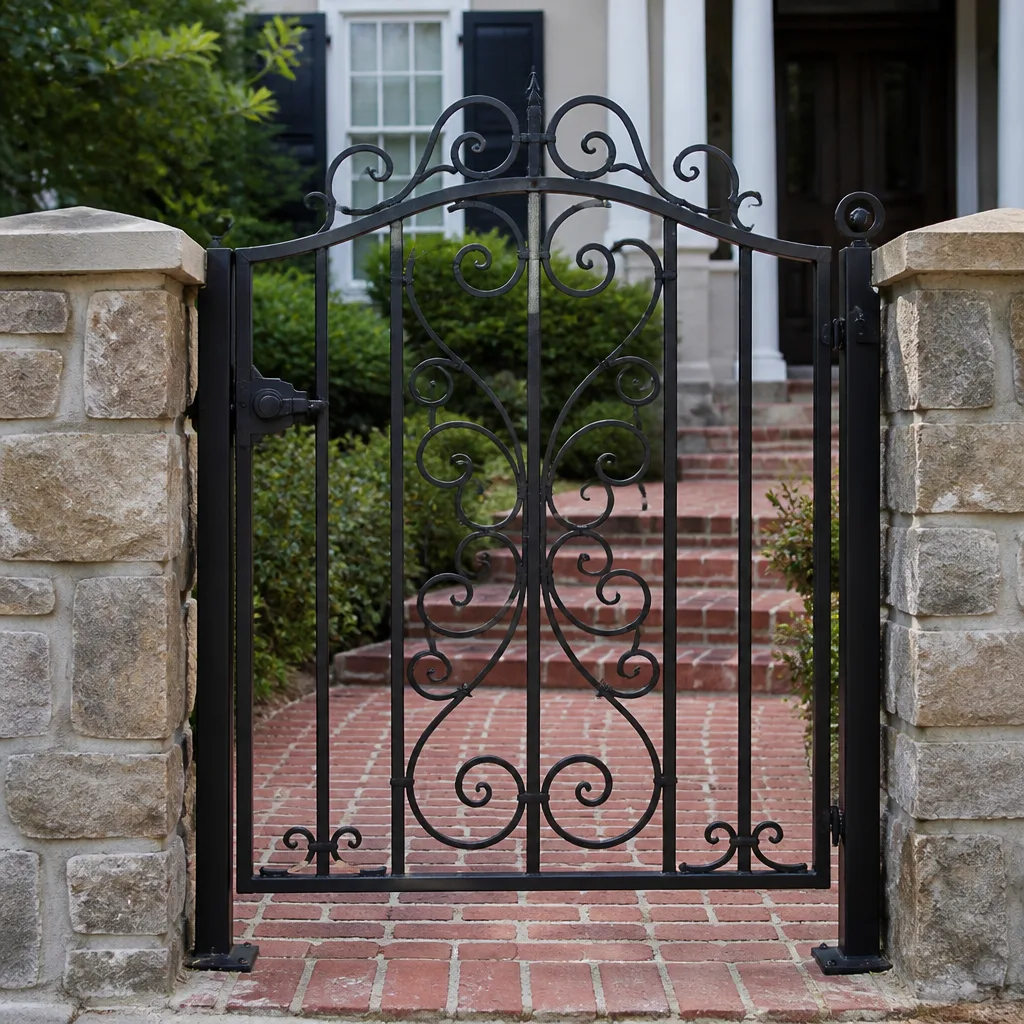 Wrought iron
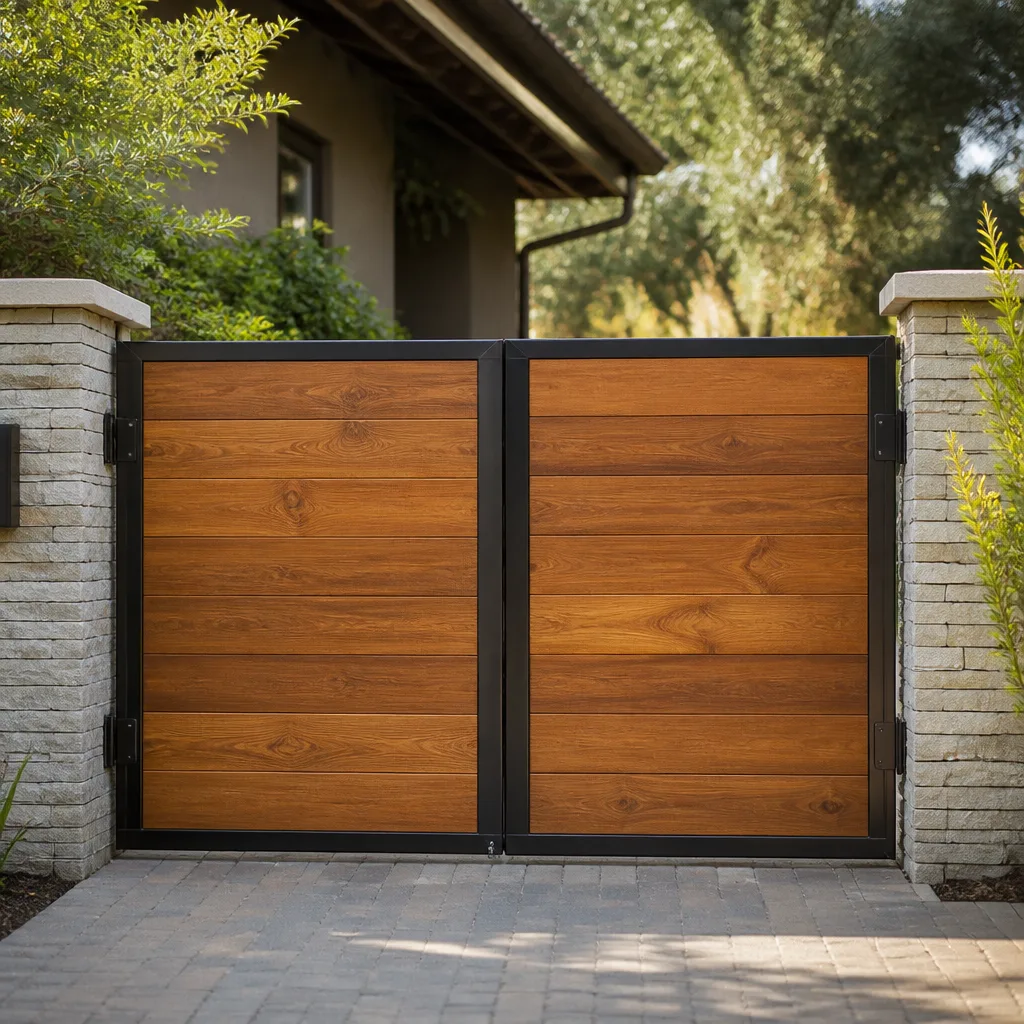 Wood & steel frame
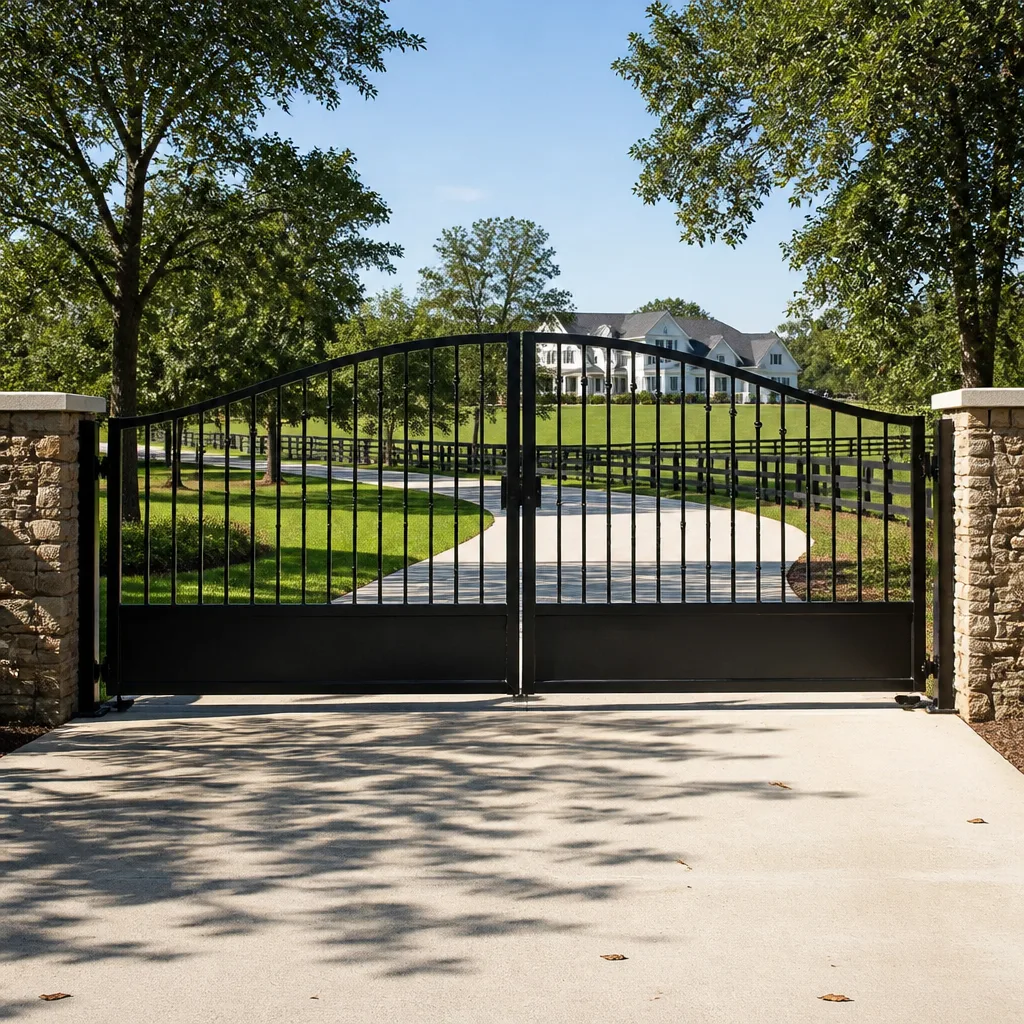 Farm & ranch
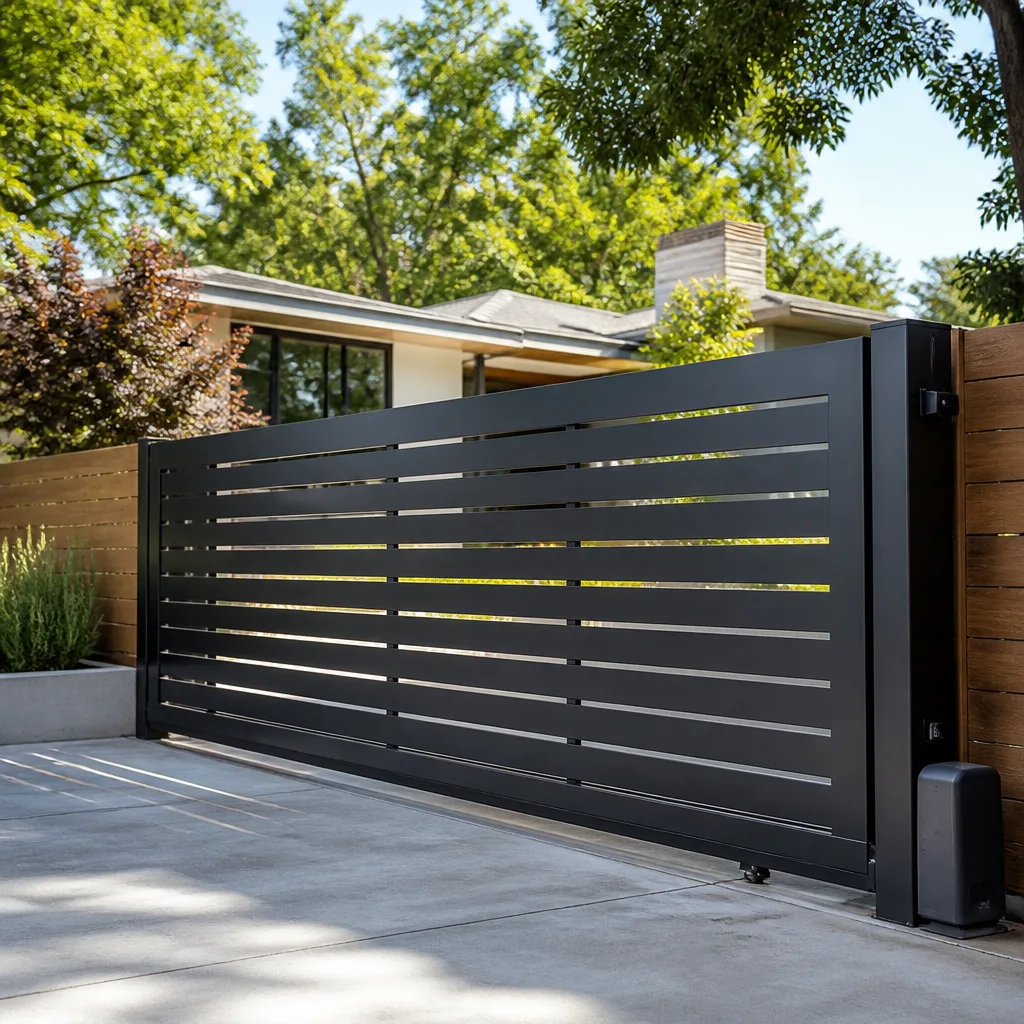 Sliding driveway gates
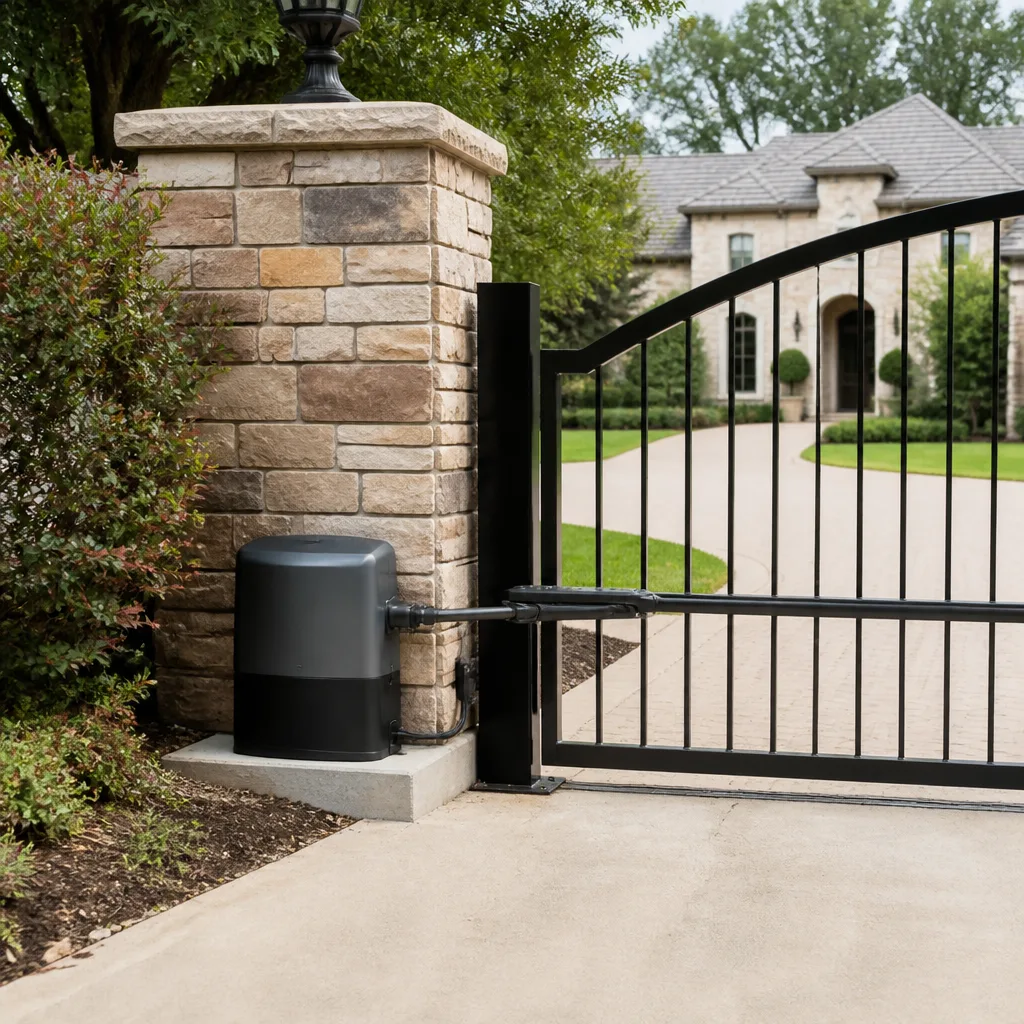 LiftMaster operators
Free on-site gate assessment - hinges, posts, and your LiftMaster or Nice gate operator checked before anything is quoted
The assessment is free and the quote is the invoice.
Get your free estimateThe Complete Guide to Gate Repair in Las Vegas
Las Vegas logs over 300 sunny days a year, and that relentless UV exposure bleaches, warps, and embrittles gate components roughly three times faster than the national average. Most repair guides are written for moderate climates, where gates rust and wear on a predictable timeline. Here, the sun, the soil, and the water do things to iron, electronics, and welds that a Seattle or Chicago contractor will never see. This guide explains why Las Vegas gates actually fail, what each type of gate is most likely to need, how to get an honest quote, and when it’s worth calling someone who knows the territory instead of guessing at it.
Styles & brands we work with
Quick Answer
Gate repair in Las Vegas typically costs between $180 and $1,900 depending on what failed. The real problem with Las Vegas gates is rarely the age of the gate. It’s the environment: UV embrittlement, caliche soil movement, and hard-water calcium buildup attack different parts of a gate in ways that inland and coastal repair guides never address. A repair that only replaces the broken part and ignores the underlying cause will repeat itself within months. The fix is to identify the failure mode, correct the underlying condition, and put the work in writing before it starts.
Gate Repair in Las Vegas from Portcullis Gate Repair covers all gate types and operator brands, with a written price before any work starts.
Table of Contents
- Why Gates Fail in Las Vegas: The Three Local Culprits
- The Four Gate Types Common in Las Vegas and Their Signature Failure Modes
- Caliche Soil, Post Lean, and Misalignment
- Hard Water, Calcium Buildup, and the Cleaning Protocol That Reverses It
- Cosmetic Repair vs. Structural Repair: Why Mixing Them Up Costs You Twice
- What a Written Repair Estimate Should Itemize
- Gate Operator Brands We Service in Las Vegas
- Common Mistakes to Avoid
- When to Call a Professional
- Frequently Asked Questions
- The Bottom Line
Why Gates Fail in Las Vegas: The Three Local Culprits
We’ve been repairing gates in Las Vegas since 2008, and the pattern is consistent. Gate age matters less than gate environment. A three-year-old gate in Summerlin can look and fail like an eight-year-old gate in Ohio. Three local conditions cause most of the damage.
UV degradation. The Mojave sun doesn’t just fade the finish. It breaks down polymer bushings, hinge seals, capacitor housings, wire insulation, and plastic gear components. Polyurethane and PVC parts that are rated for 15 years in other climates turn chalky and crack here in 4 to 6. The sun also warps hollow steel uprights and top rails on south-facing gates. We see gates that are structurally sound but cosmetically destroyed on the sun-facing side while the shade side looks new. This differential heating is a real force; it pulls welds, stresses hinges, and contributes to the lean that every Las Vegas home owner has seen on a neighbor’s gate.
Caliche soil movement. Beneath the gravel and the desert landscaping, much of the Las Vegas Valley sits on caliche, a calcium carbonate layer that behaves like weak concrete. It forms in irregular lenses and doesn’t drain the way normal soil does. When moisture arrives (from irrigation, a rain event, a leaking pipe), the layer above it expands and shifts. When it dries out, it contracts. Over years, this slow freeze-thaw free cycle pushes gate posts out of plumb, sometimes only a few degrees, sometimes enough to bind the gate leaf completely. A gate cannot work correctly if the post it hangs on has moved. We’ve removed gate posts in Henderson that had visible caliche cemented to the back side of the concrete footer.
Hard-water mineral buildup. Las Vegas water averages 278 ppm hardness. That’s classified as very hard. Every sprinkler head, every drip emitter, every line spray near a gate deposits calcium and magnesium minerals on the hardware. Hinges get a white crust. Rollers chatter instead of roll. Motor gears grind through a layer of scale. Gate operator circuit boards rarely fail because of humidity in Las Vegas; they fail because scale, dust, and heat combine to cook components that were never designed for desert conditions. The fix is not another board. The fix is cleaning the environment and protecting the replacement.
Every one of these three culprits is environmental, not manufacturing. That’s the distinction that matters. A gate that breaks once is usually a part. A gate that breaks repeatedly is usually a cause that never got addressed. Removing the cause is what separates a repair from a cycle of repairs.
The Four Gate Types Common in Las Vegas and Their Signature Failure Modes
Las Vegas neighborhoods were built in waves, and each wave favors a different gate style. Knowing which type you have, and which failure is most likely for that type, saves you from paying someone to troubleshoot by trial and error.
Slide gates. Common on wider driveways and commercial properties. A slide gate travels horizontally along a steel track or on a cantilever rail system. The actuator is the motorized arm that physically pushes the gate open, and in Las Vegas, this operator is its weak point. The track or rail collects dust and debris. The rollers on a tracked gate wear unevenly when the track is not perfectly level, which happens constantly on caliche ground. The cantilever style has no ground track, but it’s more sensitive to carriage bearing wear. The most common slide-gate failures we see in Las Vegas are: track warpage and roller seizure, chain or belt stretch, and overheating limit switches. When a slide gate starts grinding and hesitating, it’s usually a carrier or track issue, not a failed motor.
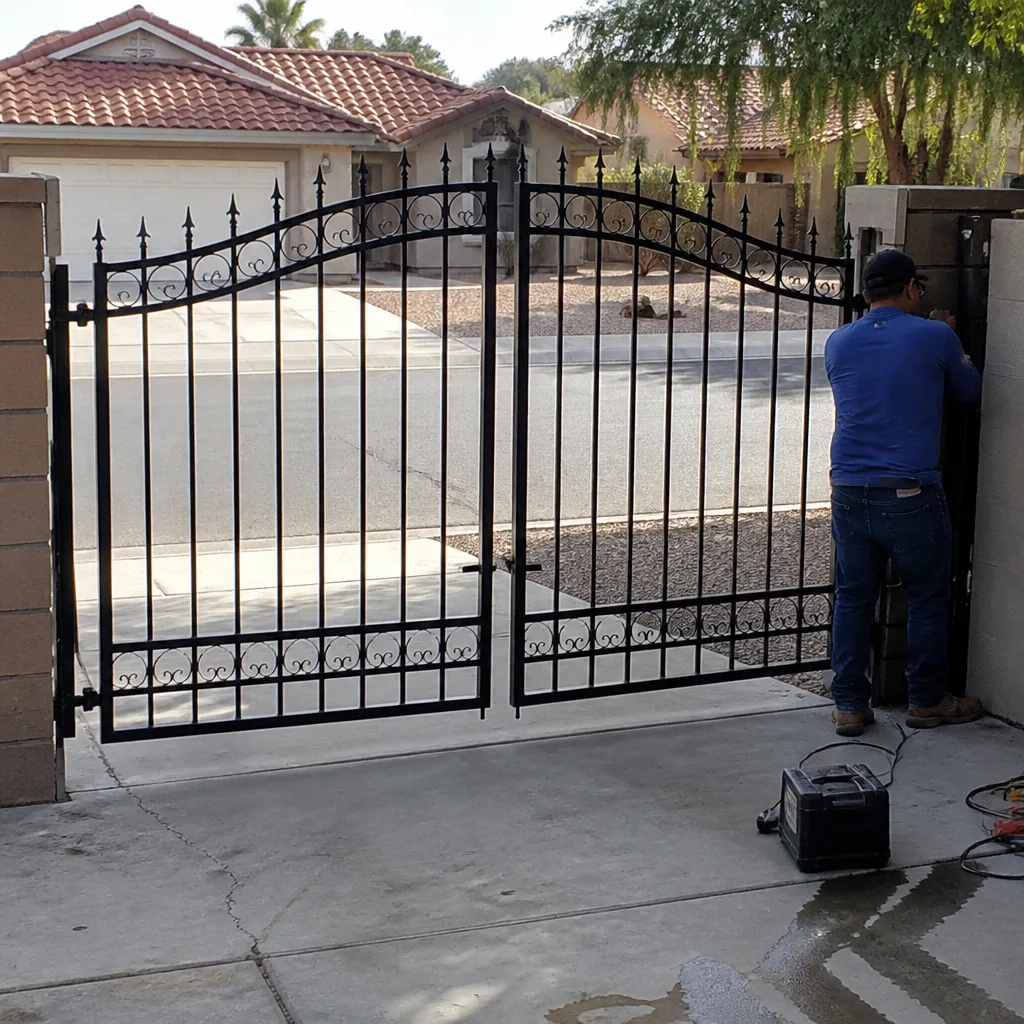
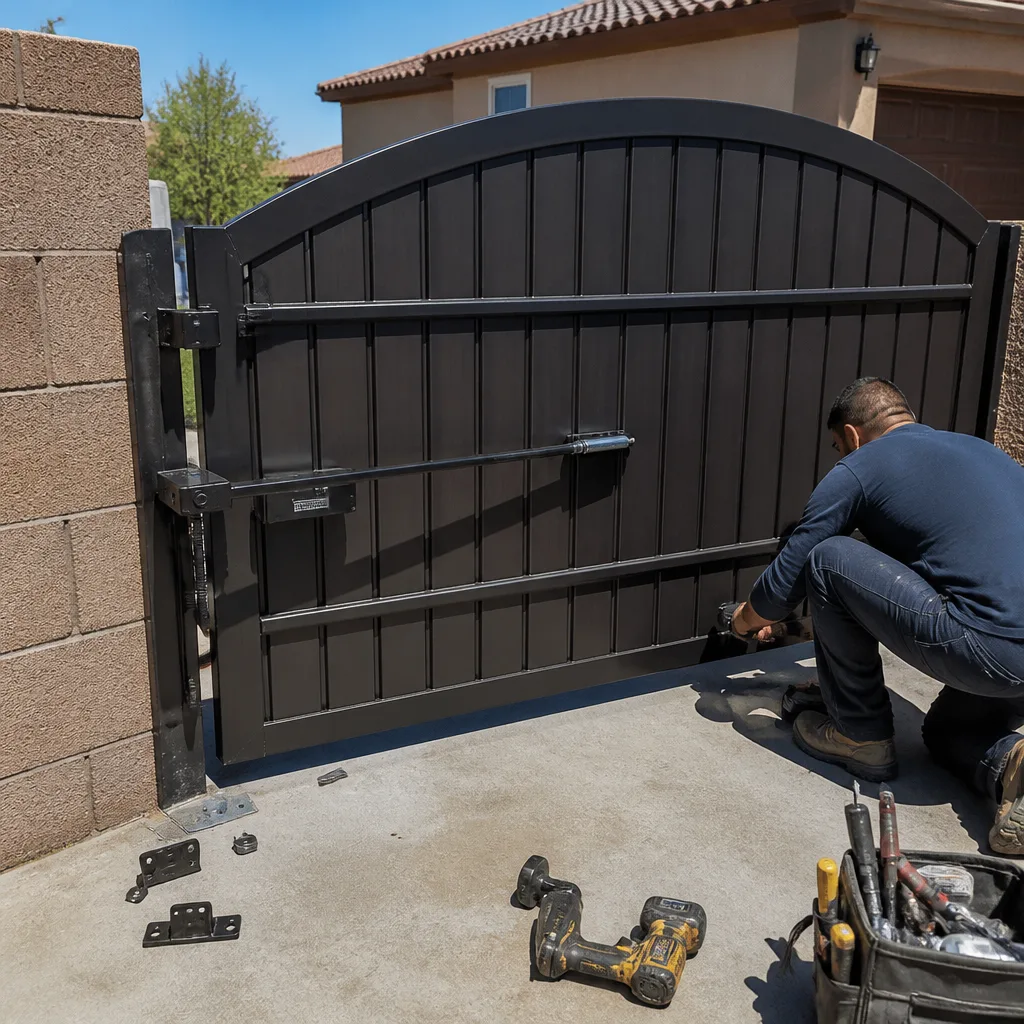
Swing gates. The most common residential style in Las Vegas: single-leaf or double-leaf. Swing gates hang on posts and swing on hinges. The failure mode here is hinge sag and post lean. As the soil shifts, the post moves, and the leaf drops. The leaf scrapes the ground or the latch no longer aligns with the post. Homeowners often adjust the actuator or replace the latch only to see the problem return. The deeper issue is the post. Swing gates also have more exposed wiring at the hinge point than slide gates, so UV-baked insulation and broken conductors at the flex point are frequent electrical faults.
Bi-fold gates. Usually a driveway gate in front of a small front yard or a walk gate at a side entrance. The bi-fold folds in half as it opens, so it requires less depth. Its weakness is the center hinge and the guide wheel at the bottom. When hard water deposits scale on the carriage or the guide track, the gate starts to bind, then folds unevenly. We see home owners force it, which accelerates wear on the upper and lower pivots. Bi-fold gates are simple, but they punish neglect quickly.
Vertical pivot gates. Less common, found on high-security commercial sites or tight urban installs. The gate arm rises vertically. These systems are sensitive to bearing wear and to the balance springs or counterweights. If the balance is off by even a small margin, the operator works against more load than it was built for, which shortens the motor’s life. A vertical pivot gate that struggles to lift almost always needs bearing or balance work, not a new operator. The smart repair sequence is to correct the mechanical load before replacing any electrical part.
If you’re not sure which type you have, start with where the gate travels: along the ground (slide), over the ground (swing), in half (bi-fold), or up (vertical pivot). That tells you most of what will fail.
Caliche Soil, Post Lean, and Misalignment
In our experience, post lean is the most misdiagnosed problem in Las Vegas gate repair. It doesn’t start with a loud bang. It starts with a little hesitation, a scrape mark on the concrete, a latch that’s gradually harder to close. By the time someone calls, the gate is binding enough to strain the operator and trip the limit switches.
Here’s what’s happening below grade. Las Vegas sits in a basin with shallow caliche deposits, the calcium carbonate crust that forms where evaporation exceeds rainfall. Caliche is not uniform. It exists in lenses and plates, some a few inches thick, some several feet. Soil above and between these plates expands and contracts with moisture. Over a cycle of years, a gate post and its concrete footer can heave or tilt. An installer may have done a perfect job, set the post in concrete to the right depth, and still see movement because the ground itself shifted. The gate didn’t fail. The earth moved.
We’ve seen driveways in North Las Vegas and Spring Valley where the post had moved half an inch relative to the operator post. Half an inch doesn’t sound like much, but at the end of a 14-foot gate leaf, that’s a 3- or 4-inch drop at the latch. A gate that used to open and close quietly now grinds. The fix is not to shim the hinge and call it done. The fix is to reset or brace the post, then re-hang the leaf and re-time the operator.
The repair sequence we follow:
- Measure the gap and plumb on both posts with a level and laser, not just a hammer and a eyeball look.
- Test for movement by loading the gate leaf and watching the post.
- Determine whether the movement is post lean, hinge wear, or both.
- Reset the post if it has moved, or repair the hinge weld points if the post is solid.
- Re-hang the leaf, set the clearances, and adjust the latch and operator limits.
- Document the corrections in writing with before and after measurements.
If someone quotes you to replace a hinge or a wheel without mentioning post lean, ask how they verified the posts are still plumb. That’s the question that separates a fix from a repeat call.
Hard Water, Calcium Buildup, and the Cleaning Protocol That Reverses It
Las Vegas averages 278 ppm water hardness. That mineral density means every landscape irrigation spray, every drip loop, every puddle from a sloped driveway leaves scale behind when it evaporates. On gate hardware, the white crust builds on hinges, roller wheels, guide tracks, latch mechanisms, and gear teeth. It’s not cosmetic. Scale is abrasive. A roller embedded with calcium cuts into the track. A gear train loaded with scale draws more current. A keypad or card reader with crusted buttons stops reading inputs.
The cleaning protocol we use on Las Vegas gates is specific for a reason. Household vinegar and a toothbrush are not enough. Here’s the sequence that actually reverses the buildup without damaging seals, powder coat, or electronics:
- Photograph the gate and hardware before any cleaning, so bearing surfaces and seal positions are documented.
- Brush off loose material with a nylon brush. No wire wheels on coated surfaces, no pressure washers near electronics or bearing seals.
- Apply a food-grade descaler or a diluted citric acid solution to the crusted metal only. Let it dwell long enough to soften the carbonate, but not so long that it etches the finish. Rinse with low-pressure water and dry with compressed air.
- On rollers and hinges, remove the components if possible, descaled them off the gate, then lubricate with a dry PTFE or silicone lubricant. Wet greases hold desert dust and turn into grinding paste.
- On operator gears and chains, clean the drive components, inspect chain tension, and re-lubricate with the manufacturer’s specified product.
- Reassemble, cycle the gate several times, and listen for noise changes. Crunching means remaining scale. Scraping means a bearing or wheel issue.
This is not monthly maintenance. On a Las Vegas gate near irrigation, once a year is realistic. The giveaway is white crust you can feel with a fingernail. Catch it at the crust stage and you avoid replacing rollers, gears, and boards later.
Cosmetic Repair vs. Structural Repair: Why Mixing Them Up Costs You Twice
A gate can look terrible and work fine. A gate can look clean and be a dangerous structural failure waiting to drop. Understanding the difference matters because the industry sometimes blurs it. A handyman may quote you to sand and repaint a rusted hinge, and ignore that the hinge post is moving. A tech may quote a new operator motor for a gate that simply has a collapsed roller. Neither fixes the actual problem.
Cosmetic work affects appearance only: powder coat fading, surface rust on the frame, paint chips, tarnished hardware, faded operator covers. Cosmetic work can be worthwhile and should be priced like cosmetic work. It will not stop a bind, quiet a grind, or prevent a post from leaning.
Structural work affects the load path: a cracked weld at a gate leaf corner, a bent track, a moving post, a failed hinge, a broken carriage, a sagging top rail. Structural failures get worse under load. A cracked weld on a 300-pound gate leaf is not going to heal itself. It’s going to tear further and eventually drop the leaf or snap at the worst time.
The risk is when a contractor treats a structural issue cosmetically because the structural fix is expensive. Painting over a crack in a stressed weld is not a repair. Replacing a wheel on a bent track is not a repair. The gate will fail again, and sometimes the second failure damages the operator, the vehicle, or a person. A good written estimate will tell you which category the work falls into and why. If the estimate doesn’t say, ask.
What a Written Repair Estimate Should Itemize
We write every Portcullis gate repair estimate before any work starts. It’s not because customers ask for it. It’s because the lack of a written price is where most gate repair horror stories begin. A technician arrives, disassembles the gate, discovers more problems, and the price doubles after the fact. The homeowner pays because the gate is in pieces on the driveway.
A useful written estimate for gate repair in Las Vegas itemizes at least these five things:
- Parts with brand and part number where possible. Reliable operators list LiftMaster, FAAC, BFT, Linear, Viking, Ghost Controls, DoorKing, Elite, or Mighty Mule explicitly. “Generic replacement motor” tells you nothing.
- Labor as a line item with the scope spelled out: reset post, replace hinges, clean and re-lube drive, re-time operator. If the scope is vague, the price can later expand.
- Warranty in writing: what it covers, how long it lasts, and what voids it. The industry minimum for a gate repair is usually 90 days. The Kingswell Guarantee is written for 365 days.
- Exclusions plainly stated: asphalt patch, concrete repair, electrical service upgrades, or anything else not included. If the list is missing, assume nothing is included.
- Timeline: when work starts, and a real arrival window, not “sometime Tuesday.”
A written estimate lets you compare two companies on equal footing. If one quote is lower because it omits the warranty or the post reset, it’s not lower. It’s just incomplete.
Gate Operator Brands We Service in Las Vegas
The operator is the motorized brain and muscle of an automatic gate. Different brands have different control boards, limit systems, and drive mechanisms. A technician who services one brand well may not know the quirks of another. Our techs are trained on nine major gate-operator brands: LiftMaster, FAAC, BFT, Linear, Viking, Ghost Controls, DoorKing, Elite, and Mighty Mule. That matters because the arriving technician should already know the specific system on your property, not spend the first hour reading the manual.
In Las Vegas, two brands dominate residential installs. Linear and LiftMaster appear on thousands of HOA and custom-home gates across Summerlin, Henderson, and the northwest valley. Ghost Controls and Mighty Mule are popular on DIY and retrofit openers on estate properties and small ranches outside the valley. BFT is common on Italian-made operators at higher-end homes and commercial properties. Viking appears on commercial slide gates and barrier arms. DoorKing is the standard on apartment communities and commercial access systems. Elite appears on heavy-duty industrial gates and some solar-powered operators. If the gate has a brand name and a model, we service it. If it’s a no-name import, we can typically identify the compatible replacement or retrofit it with a known-brand operator.
Electric Gate Repair in Las Vegas is where operator-specific diagnostics and motor swap detail lives. The operator is the most expensive component on an automatic gate, so a correct diagnosis beats a hopeful parts swap every time.
Common Mistakes to Avoid
- Forcing a gate that suddenly binds. A gate that scraped or hardened overnight has a mechanical cause. Forcing it open or closed by hand or with the operator strains every part on the load path, and often turns a $200 hinge repair into a $900 operator replacement.
- Lubricating without cleaning first. Spraying oil on desert dust and calcium crust creates grinding paste. Clean the surface, then lubricate with a dry PTFE or silicone product. It’s a small step that determines whether the fix lasts months or years.
- Replacing a part without looking at the post. If the post is out of plumb, a new hinge or wheel will carry the same bad geometry. The wear will return. Verify the post before accepting a parts-only quote.
- Accepting a quote that doesn’t list parts, labor, and warranty separately. If the estimate is a single number with no breakdown, there’s nothing to compare and nothing to enforce. Written line items protect you.
- Ignoring the safety edges and photo eyes. After a repair, the entrapment protections must be re-checked and re-adjusted. A gate that closes on a car or a person is an injury risk. This isn’t optional.
- Letting irrigation spray hit a gate year-round. Hard-water scale is preventable. Redirecting a sprinkler head away from hinges and rollers costs nothing and saves hundreds over the life of the gate.
- Choosing a contractor based on the cheapest online ad. In Las Vegas, the gate repair market is crowded with unlicensed individuals and handyman services. If the person on the phone can’t tell you whether your slide gate is tracked or cantilever, they’re not the person to repair it.
When to Call a Professional
Call a professional gate repair company when the gate makes a new noise, binds, scrapes, reverses on its own, or trips a breaker. Call when a post is visibly leaning or a weld is cracked. Call when the operator is running but the gate isn’t moving, or the gate is moving but the operator won’t stop. These are not maintenance-level problems. They are load, voltage, or structural problems, and the wrong guess often makes the repair more expensive. Portcullis Gate Repair Las Vegas offers free estimates in Las Vegas and the surrounding valley. Call (725) 777-5391 or visit our Portcullis Gate Repair Las Vegas home page to get on the schedule.
If you’re considering a full replacement instead of a repair, see Gate Installation in Las Vegas for what a new install involves in the valley’s soil and climate.
Frequently Asked Questions
Most gate repairs in Las Vegas run $180 to $1,900 depending on the type of gate and the failed component. A hinge replacement on a light residential swing gate starts around $180 to $350, while a full operator swap on a slide gate typically runs $900 to $1,900 with parts and labor. Post resets and structural weld repairs land in the middle, depending on how much of the old concrete work has to be redone.
Portcullis Gate Repair Las Vegas answers every call with a live person and schedules repair visits with a real arrival window, including same-day appointments when the schedule allows. Electrical and operator failures that pose a safety hazard are prioritized. Call (725) 777-5391 to check today’s schedule.
Gate repair addresses the physical structure and mechanical hardware: posts, hinges, wheels, tracks, welds, and gate leaves. Operator repair addresses the motor and control system: the actuator, control board, remote receiver, limit switches, safety edges, and photo eyes. The two overlap because a structural problem overloads the operator and an operator problem can slam or stall the gate. A competent repair company diagnoses both sides at once.
We handle low-voltage control wiring, photo eyes, safety edges, and operator power connections as part of gate repair and Electric Gate Repair in Las Vegas. New high-voltage branch circuits or panel upgrades are handled by a licensed electrician, and we’ll point you in the right direction if your existing circuit is undersized or damaged.
A full gate installation includes a site assessment for caliche and drainage, post setting and concrete, the gate leaf or leaves, hinges or track system, the operator and remote controls, safety edges and photo eyes, limit adjustment, and a written warranty. Details are on our Gate Installation in Las Vegas page, and estimates are always written before work begins.
A repair that addresses the actual failure mode should last years, not months. Environmental factors like hard-water spray and UV baking will still wear components, but a corrected hinge geometry, clean bearing surfaces, and a properly timed operator remove the accelerated wear. The Kingswell Guarantee covers our repairs for 365 days in writing, and if it fails inside that period, we return and fix it at no charge.
The Bottom Line
The complete fix for a Las Vegas gate starts with asking why it failed, not just what broke. Caliche soil shifts posts. UV light embrittles seals, plastics, and wires. Hard water crusts the moving parts. Replace the part and ignore the cause and you’ll be calling another repair company in six months. Address the cause, get the scope in writing, and confirm the warranty before the first bolt is turned, and the same gate usually runs quietly for years. That’s the entire game in this city. It’s a dry, bright, mineral-hard environment, and the companies that last here are the ones that understand that. We’ve been repairing Las Vegas gates since 2008, and every job still starts the same way: a written price, a real arrival window, and a 365-day written guarantee behind the work. If your gate is misbehaving, call (725) 777-5391 for a free estimate, and a live person will answer.
Written by Dean Prescott, Owner at Portcullis Gate Repair Las Vegas, serving Las Vegas since 2008.
See the difference
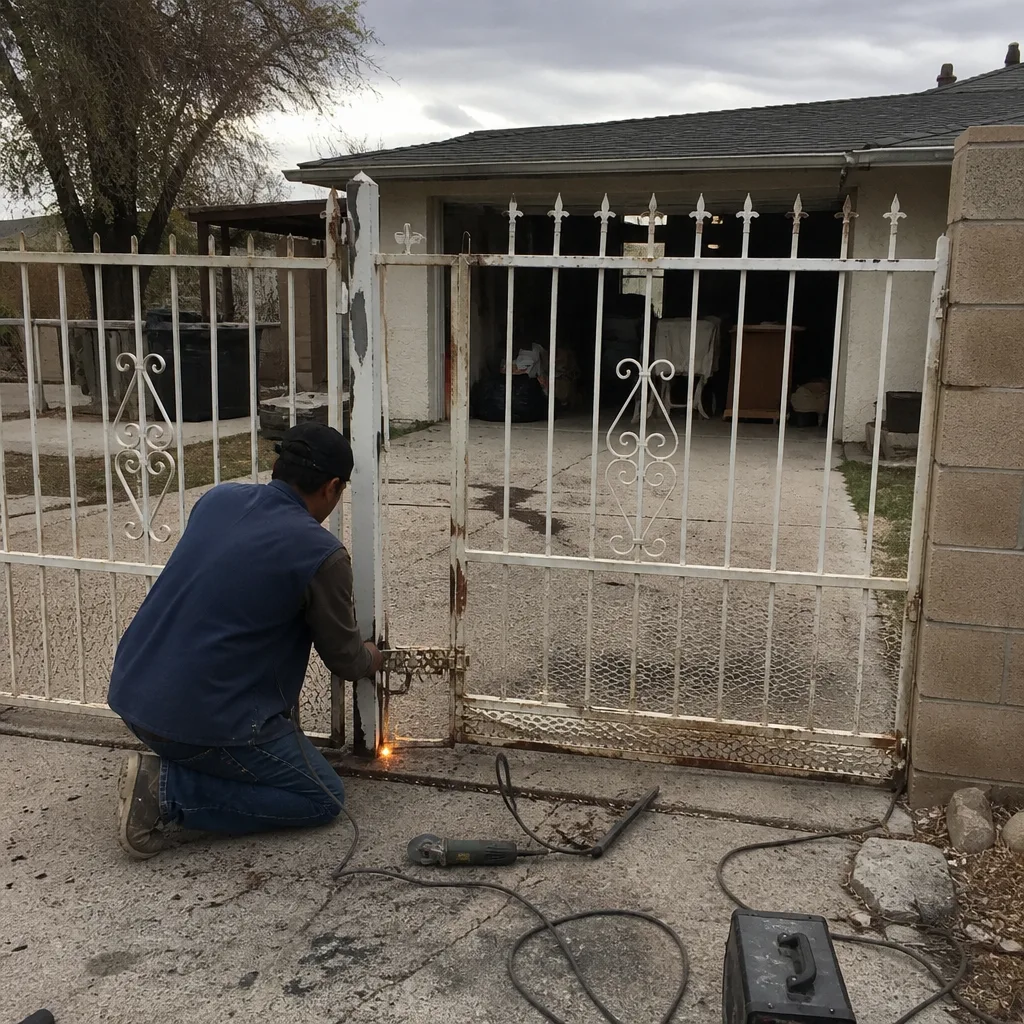 Before
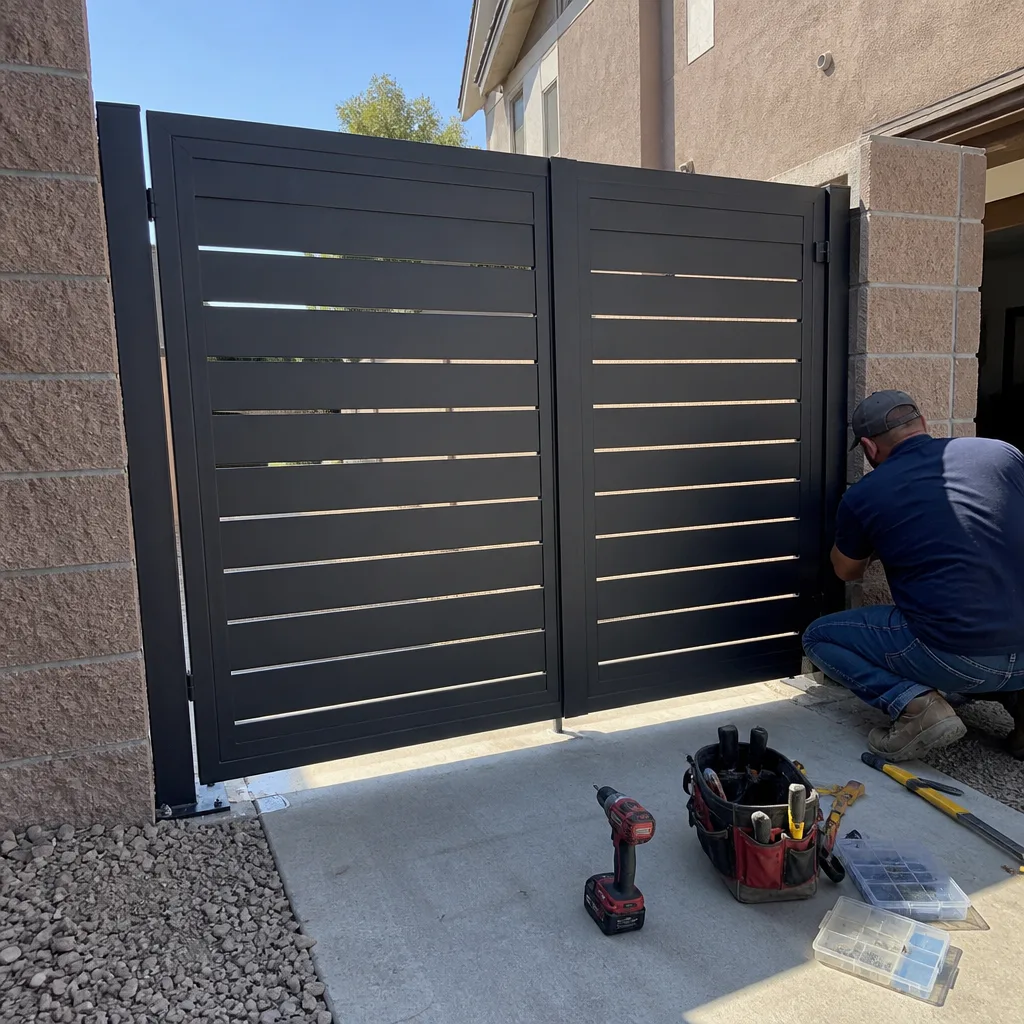 After
After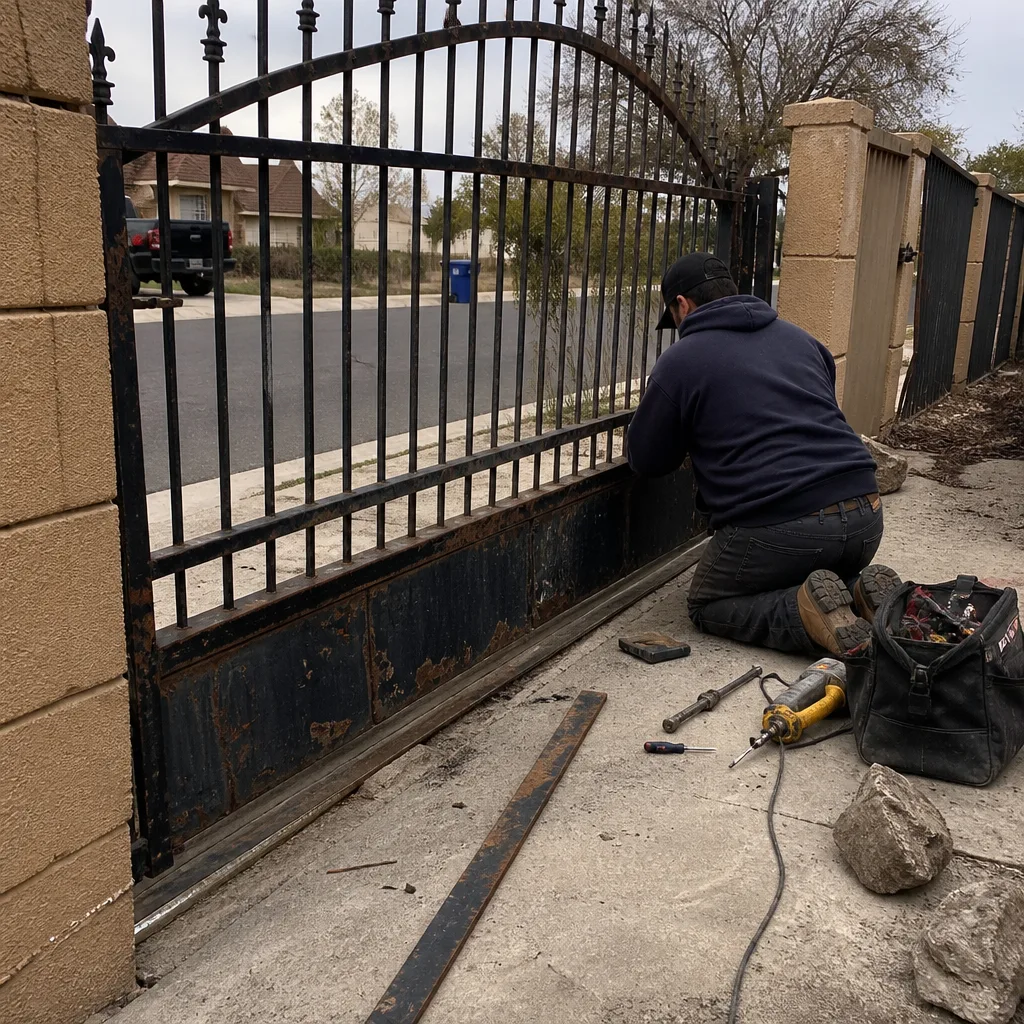 Before
 After
After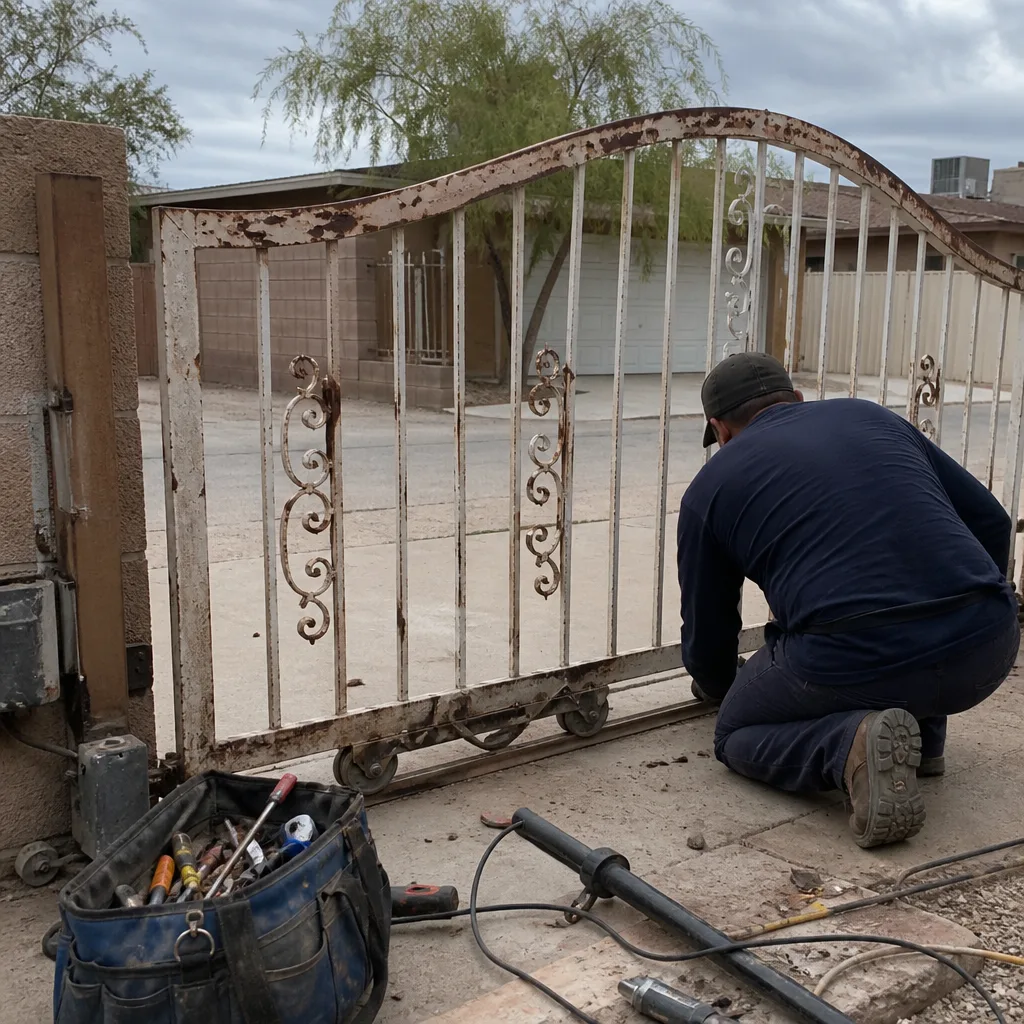 Before
 After
After