
Last updated October 16, 2026
 Wrought iron
 Wood & steel frame
 Farm & ranch
 Sliding driveway gates
 LiftMaster operators
Free on-site gate assessment - hinges, posts, and your LiftMaster or Nice gate operator checked before anything is quoted
The assessment is free and the quote is the invoice.
Get your free estimateDIY vs Professional Gate Repair: The Las Vegas Homeowner’s Decision Guide
A torsion spring on a heavy slide gate stores enough energy to break a wrist in a fraction of a second. YouTube tutorials on spring adjustment carry comment sections full of emergency room stories, yet “gate spring repair DIY” still gets tens of thousands of searches every month. In Las Vegas, where dust, heat, and wind punish gate hardware year-round, the question isn’t just about skill. It’s about which repair you’re attempting, what tools you own, and what happens when the fix fails at 11 p.m. on a Tuesday. This guide breaks down what’s genuinely safe for a homeowner, what’s a false economy, and what should never be touched without a licensed technician.
Quick Answer
For most Las Vegas homeowners, DIY gate repair is genuinely appropriate for a handful of tasks: lubrication, battery replacement, keypad reprogramming, and tightening loose hardware. Anything involving torsion springs, motor wiring, post replacement, or safety sensor alignment is either dangerous or regulated, and in our experience the DIY attempt costs more by the time a professional fixes both the original problem and the new one. If the gate won’t move, makes a grinding sound, or trips a breaker, call a pro for our Gate Repair services. If it just needs grease and a bolt tightened, grab a wrench.
Styles & brands we work with
Table of Contents
- The Real Cost Comparison: DIY vs Professional for Three Common Repairs
- Tier 1: DIY Tasks Any Homeowner Can Handle in Las Vegas
- Tier 2: DIY Tasks for the Mechanically Confident Homeowner
- Tier 3: Professional-Only Tasks, Regardless of DIY Skill
- Las Vegas-Specific Factors That Change the DIY Equation
- Nevada Code and DIY Electrical Work on Gate Operators
- How to Do the DIY Tasks Correctly
- When a DIY Repair Goes Wrong: What to Tell the Contractor
The Real Cost Comparison: DIY vs Professional for Three Common Repairs
Most DIY-versus-pro articles talk about the hourly rate and then hand-wave the math. The truth is messier. You pay for parts at retail, pay for tools you may use once, then pay a second time when the first attempt doesn’t hold. Here is what three common Las Vegas gate repairs actually cost when you run the numbers honestly. Prices are local ranges from jobs we’ve quoted and seen come through our shop in Summerlin, Henderson, and the northwest valley.
Repair 1: Failing Swing Gate Actuator
The actuator, which is the motorized arm that physically pushes the gate open, typically runs 7 to 10 years in Las Vegas heat before the internal gear train wears out. A replacement actuator for a Linear or Mighty Mule system runs $350 – $600 at retail. Add $40 – $80 for a torque-limiting drill bit set if you don’t already own one. If the mounting bracket is bent, and they usually are by the time the actuator fails, that’s another $60 – $120. Your DIY total lands around $450 – $800. A professional repair from a shop like ours typically runs $650 – $1,000 parts and labor, and that includes the written guarantee. The difference narrows fast when you factor in the two Saturday afternoons and the real possibility that you’ll order the wrong stroke-length actuator and have to deal with a return.
Repair 2: Dead Keypad or Receiver Board
Keypads die from UV exposure and heat cycling. A replacement keypad for a DoorKing or Ghost Controls system costs $45 – $120 online, and a new receiver board runs $90 – $220. This is a genuinely homeowner-friendly repair if you can match the wiring diagram. Professional repair typically runs $180 – $350 including the part. The real hazard here isn’t the wiring, though. It’s ordering the wrong frequency or protocol. If the new keypad doesn’t talk to the old board, you now own a keypad-shaped paperweight and still need a new receiver.
Repair 3: Gate Off Its Lower Track or Hinges Pulling from the Post
This is where DIY math falls apart completely. The parts are cheap: a replacement wheel assembly might run $30 – $60. But you need a 6-ton bottle jack or a gate lift to get the gate back on the rail, and that’s a $40 – $80 rental, plus the risk of the gate tipping. When hinges pull from the post, the fix is not longer lag bolts. The post is rotted or the concrete is cracked, and the proper repair means putting in a new post or epoxy-setting new anchors. Professional post replacement in Las Vegas typically runs $400 – $1,200 depending on whether the post is set in concrete, brick, or block. Attempting a lag-bolt fix on a compromised post buys you three months, at most, before the gate sags again and the original problem returns plus the new stripped holes.
Tier 1: DIY Tasks Any Homeowner Can Handle in Las Vegas
These repairs require no special training, no dangerous tools, and no risk of personal injury. You are essentially performing maintenance the manufacturer expects the homeowner to do. Our Gate Repair in Las Vegas team fields calls every week from homeowners who could have handled these themselves in under an hour, and we tell them exactly that.
- Lubricating hinges, rollers, and the actuator arm. Use a white lithium grease or a silicone spray made for metal-to-metal contact. In Las Vegas dust, avoid WD-40 as a primary lubricant; it attracts dust and turns into a grinding paste within a month. Wipe down the hinge pin, apply grease, and cycle the gate three times to distribute it.
- Replacing keypad batteries. If the keypad still lights up but the range is shrinking, the 9-volt or AA batteries inside are dying. Pop the cover, swap the batteries, and re-enter your code. On most Linear, Viking, and Mighty Mule keypads, the programming holds through a battery change.
- Tightening loose hardware. Gate hinge bolts and bracket bolts work loose over time, especially on the freeze-thaw cycles of Las Vegas winters, which are mild by national standards but still cycle enough to walk a bolt out. Use a socket wrench and tighten to snug, not to maximum torque.
- Clearing debris from the track. Gravel, palm fronds, and tumbleweeds from spring winds end up in slide gate tracks constantly. Pull the debris out by hand or with a broom. Do not use a pressure washer, which drives dirt into the wheel bearings.
None of these tasks voids a manufacturer warranty when done correctly. They cost nothing but time and a can of grease.
Tier 2: DIY Tasks for the Mechanically Confident Homeowner
This tier is where Las Vegas homeowners who have rebuilt a carburetor or wired a ceiling fan start to feel confident. The tasks here are doable with a socket set, a multimeter, and patience, but they carry a real consequence if you get them wrong. We recommend you attempt these only if you can read a wiring diagram and own a torque wrench, or at least rent one.
Replacing a Keypad or Receiver Board
Most gate keypads and receiver boards use low-voltage DC wiring, 12 to 24 volts. The shock risk is minimal. The risk is wiring the new part wrong and shorting the control board. The fix for that is a $150 to $400 replacement board, which turns your $60 DIY project into a $400 repair. Read the wiring diagram twice before you disconnect anything, and photograph the existing wiring from three angles before you touch a terminal. When you install the new part, match wire for wire and test the gate with a temporary block under it so it can’t close on anyone.
Replacing a Belt on a Slide Gate Operator
Belt replacement is a known lazy-Sunday job for the mechanically inclined. A new belt for a DoorKing or Linear slide operator runs $40 – $130. The process is: disconnect power, remove the cover, release the belt tension, pull the old belt, thread the new one, tension it so it deflects about 1/4 inch under a firm thumb press, and reassemble. It takes about 90 minutes. The risk is under-tensioning, which lets the belt slip and wear the drive pulley, or over-tensioning, which burns out the motor bearing. If you finish and the belt whines, you over-tensioned it. Loosen and re-set.
Resetting and Reprogramming a Ghost Controls or Viking Operator
Factory resets are squarely in the homeowner-appropriate category, because the manufacturer publishes the reset sequence in the manual. The sequence usually involves holding a learn button or a combination of button presses. The danger is that a reset wipes the force and limit settings, and if you don’t re-set the limits correctly, the gate will travel too far or not far enough and strain the operator. Always re-set force limits after a reset, and test the auto-reverse safety by blocking the gate with a 2×4 laid flat. If the gate doesn’t reverse within two seconds of contact, stop using the operator and call a tech.
Tier 3: Professional-Only Tasks, Regardless of DIY Skill
These are the tasks where we stop writing instructions and start writing warnings. The energy stored in a torsion spring or a wound cable is not forgiving, and the voltages inside an operator’s capacitor circuits can knock you off a ladder. Even if you survive the repair, doing these wrong creates a gate that can crush a child, a pet, or a delivery driver. That’s not a rhetorical sentence. A 400-pound slide gate moving at full speed will not stop because you shout at it.
- Torsion spring adjustment or replacement. A torsion spring on a slide gate is wound to hundreds of foot-pounds of stored torque. When it slips, it does not unwind slowly. It goes in one violent rotation that takes fingers, a hand, or whatever else is in the wind plane. In Las Vegas, springs on western-exposure gates fatigue faster because of the direct afternoon sun. We use proper winding bars and a respect for the stored energy, and even then we treat every spring job like a bomb disposal.
- Motor or capacitor replacement with live 120V or 240V circuits. The operator’s motor side is line voltage. The capacitor holds a charge even after the breaker is off. A homeowner who discharges a 240V capacitor through a ring on their finger learns a lesson they will not enjoy. Do not open the operator housing beyond the belt and limit switch covers.
- Post replacement for hinge posts. A leaning gate post in Las Vegas is usually the result of wind load plus water intrusion cracking the concrete footing. Replacing it means cutting the gate free, jackhammering the old footing, setting a new post in high-strength concrete, and letting it cure before rehanging the gate. This is a two-person job with real lifting and real geometry.
- Safety sensor and photo-eye alignment. All modern automatic gate operators are required by UL 325 and Nevada code to have an auto-reverse safety function and, on many installations, monitored photo eyes on both sides of the gate. If you bump a photo eye out of alignment and your gate no longer reverses on contact, you have created a hazard that can seriously injure a person. Sensor alignment and testing is a tech-level job.
- Any wiring that runs under a driveway or through a wall. In Las Vegas, buried low-voltage cable runs through conduit or direct-burial cable in a trench. If your gate lost power and you think the wire is broken underground, locating the break requires a wire tracer and excavation. Digging blind through your own yard to find a 24-volt wire is a poor trade for your Saturday.
If you are even slightly unsure, the Electric Gate Repair in Las Vegas page lays out how our techs diagnose and quote these systems.
Las Vegas-Specific Factors That Change the DIY Equation
The national DIY advice assumes a mild climate and a gate that gets used twice a day. Las Vegas gates get used 8 to 14 times a day. They bake in 110° heat. They face 40 mph afternoon winds every spring. And the air is dry enough to pull moisture out of grease, rubber seals, and plastic bushings. What works in Ohio often fails out here, and the failure usually comes faster than a YouTube tutorial prepares you for.
Heat and UV Degradation
Actuator arms, keypad housings, and plastic gear covers crack under relentless UV. A DIY fix that doesn’t account for this, like using a standard-grade grease on a hinge that sits in direct sun, lasts months instead of years. We specify high-temp synthetic grease for hinges and actuators in the Las Vegas market. Any homeowner can apply it, but buying the right product matters. The wrong product fails quietly, then the gate stops opening at the worst possible moment.
Dust and Sand Intrusion
Las Vegas sits in a bowl, and every breeze picks up fine particulate. That dust works its way into roller bearings, limit switch housings, and keypad buttons. The fix for a sticky keypad out here is usually a contact cleaner flush, not a new keypad. Homeowners who replace the keypad without cleaning the connector often find the new one sticks within months and think it’s a defect. It isn’t. It’s the environment.
Wind Loading on Oversized Gates
Many Las Vegas homes, especially in gated communities and horse-property areas on the outskirts of town, have oversized ornamental gates that act like sails in a windstorm. The wind load on a 16-foot gate during a 40 mph gust exceeds what a small operator is rated to handle. If your gate shudders or stalls in the wind, the problem isn’t that the motor is weak. It’s that the gate was either undersized for the operator or the gate’s geometry changed over time. That’s a diagnosis job, not a parts-swap job.
Nevada Code and DIY Electrical Work on Gate Operators
This is the section most DIY articles skip, and it matters. In Nevada, most municipalities follow the National Electrical Code, which treats automatic gate operators as appliances, not as branch circuits. But any line-voltage wiring, meaning 120V or 240V that feeds the operator, falls under the same permitting requirements as any other fixed electrical installation. In Clark County, including unincorporated Las Vegas, a homeowner can legally pull a permit for electrical work on their own residence. That much is true.
What most homeowners miss is the UL 325 standard. Every automatic gate operator sold in the United States must comply with UL 325, which mandates specific safety features: a primary entrapment protection device and a secondary protection, such as monitored photo eyes or a contact edge. When you replace or adjust an operator and the installation no longer meets UL 325, you can be held liable for any injury that results. Liability insurance for a homeowner does not necessarily cover injuries caused by an automatic gate that the homeowner modified.
In practice, the permitting conversation matters most when the repair involves the line-voltage side: replacing a motor, rewiring an operator, or adding a new operator to an existing gate. A homeowner who wires a new Viking or Ghost Controls operator to a new 120V circuit without a permit and an inspection is accepting liability for everything that gate does afterward. Our techs work to code because the consequences of not doing so don’t show up for years, and then they show up as a lawsuit.
How to Do the DIY Tasks Correctly
If you’re going to do the Tier 1 and Tier 2 tasks yourself, here are the specifics most articles skip. Getting these details right is the difference between a repair that lasts and a repair that fails in front of company-see our Gate Repair Maintenance Checklist for Las Vegas Homeowners for the full routine.
The Right Lubricant for Las Vegas Gates
For metal hinge pins and actuator arms, use a synthetic, high-temp white lithium grease rated to at least 250°F. Regular lithium grease breaks down at Las Vegas summer temperatures and runs out of the hinge. For slide gate roller bearings, use a dry-film lubricant or a light silicone spray, not grease. Grease grabs dust and forms a grinding compound. For the chain or belt on a slide operator, most manufacturers in the Mighty Mule, Linear, and DoorKing lines recommend a light machine oil applied sparingly, or no lubricant at all on certain belts. Check the manual for your specific operator. Over-lubricating a belt causes slip, which wears the pulley.
Correct Torque for Gate Hinge Bolts
Hinge bolts on a residential gate are typically 1/2-inch or 5/8-inch diameter, and the correct torque is 50 – 75 foot-pounds for a 1/2-inch grade 5 bolt into solid steel or set into epoxy anchors. Overtorquing strips the threads or snaps the bolt. Undertorquing lets the gate sag. If you don’t own a torque wrench, rent one for $10 from a local tool library or auto parts store. It’s cheaper than drilling out a snapped bolt.
Testing Auto-Reverse After Any Motor or Limit Adjustment
After any repair that touches the operator, limits, or controller, test the auto-reverse function with a rigid object. Lay a 4×4 or a filled garbage can in the gate’s path and run the gate against it. The gate should reverse within two seconds of contact. If it doesn’t, stop using the gate and call a technician. This test is the single most important safety step in gate ownership, and most DIY tutorials never mention it.
When a DIY Repair Goes Wrong: What to Tell the Contractor
Every gate tech in Las Vegas has walked up to a gate and seen the signs: misaligned brackets, stripped screws, fresh paint over new welds, and a homeowner who says, “It just stopped working.” Here is the thing. We can tell when a repair was attempted, and we don’t judge it. What we do need is honesty about what was done and when.
When you call us for a Gate Installation in Las Vegas repair after a DIY attempt, tell us the truth. Specifically: what parts you replaced, whether you adjusted the limits or force settings, whether the gate was ever dropped or propped, and what the gate did immediately before it stopped working. That information saves us an hour of diagnosis, and that hour is your money. If you hide the attempted repair, we find it anyway, and the diagnostic time doubles. Hiding it does not make the fix cheaper. It makes it slower.
The most common half-finished DIY repair we see is a spring adjustment where the homeowner got the bar in, turned the spring half a turn, lost their nerve, and left the set screws loose. Then the spring slowly unwinds over two months, the gate starts slamming at the end of travel, and the operator’s gearbox eats itself. By the time we see it, the repair is a spring job plus a new gear set. None of that was necessary.
Common Mistakes to Avoid
- Using WD-40 on hinges and calling it done. WD-40 is a solvent, not a lubricant. It flushes out the old grease and leaves bare metal. In Las Vegas dust, that bare metal starts grinding within a month.
- Assuming a 24-volt system can’t hurt you. The control side is low voltage, but the capacitor in the operator can hold a charge that knocks you flat. Kill the breaker and discharge the capacitor before touching anything inside the housing.
- Buying parts by brand name only. A “Linear actuator” is not one thing. Stroke length, force rating, and mounting style vary across models. Buying the wrong actuator is the single most common wasted DIY purchase we see.
- Adjusting the gate’s force settings to “fix” a dragging gate. If the gate scrapes or hesitates, the problem is mechanical, not electronic. Cranking the force makes the gate dangerous and fails to fix the drag. You now have a sticking gate with a stronger motor behind it.
- Replacing the operator before checking the power supply. In Las Vegas, a gate that won’t open is often a tripped GFCI, a dead battery in a solar operator, or a buried wire that a landscaper nicked. A new operator doesn’t fix any of those.
- Ignoring the safety sensors after a repair. If you moved the photo eyes or changed the gate’s travel, you have to re-test the auto-reverse. An untested gate is a liability and a hazard, full stop.
- Thinking a sagging gate is a hinge problem. Sag usually starts at the post or the footing, not the hinge. Replacing hinges on a compromised post is rearranging deck chairs.
See the difference
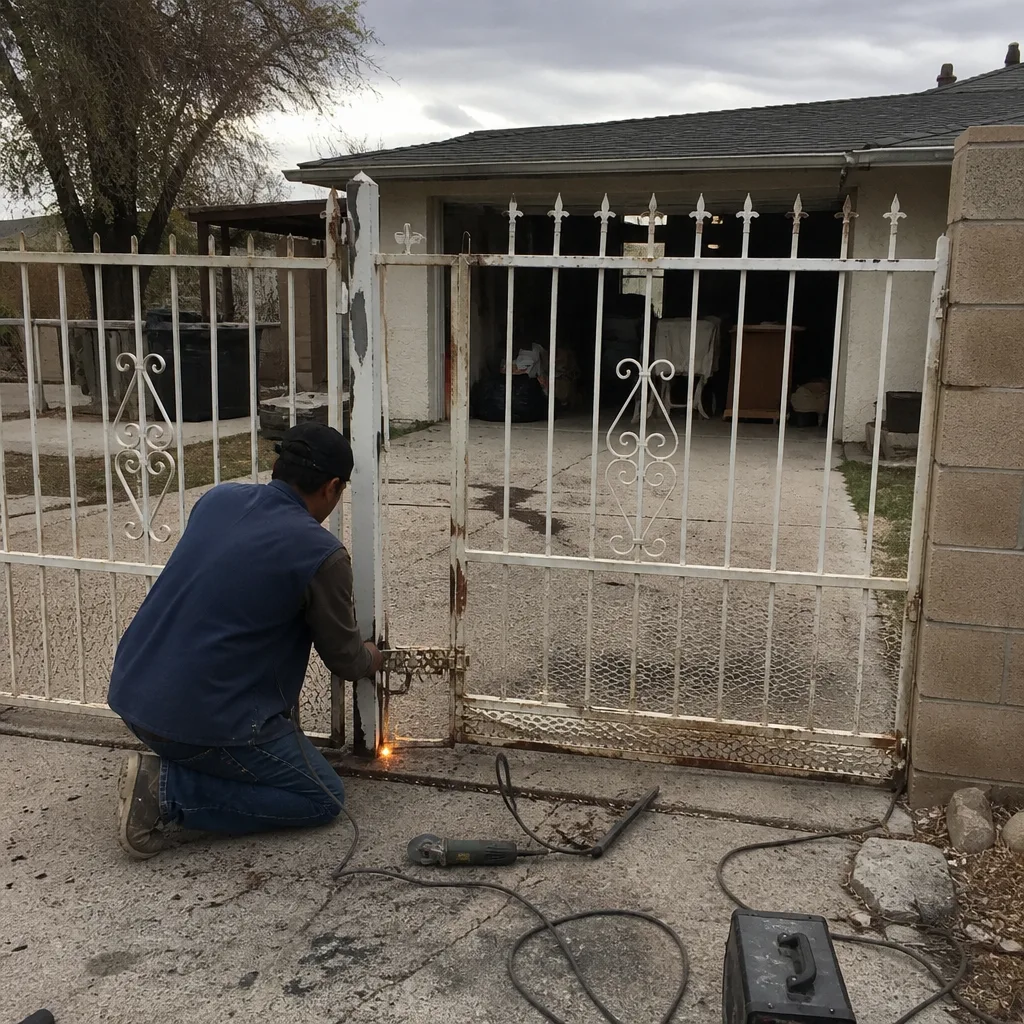 Before
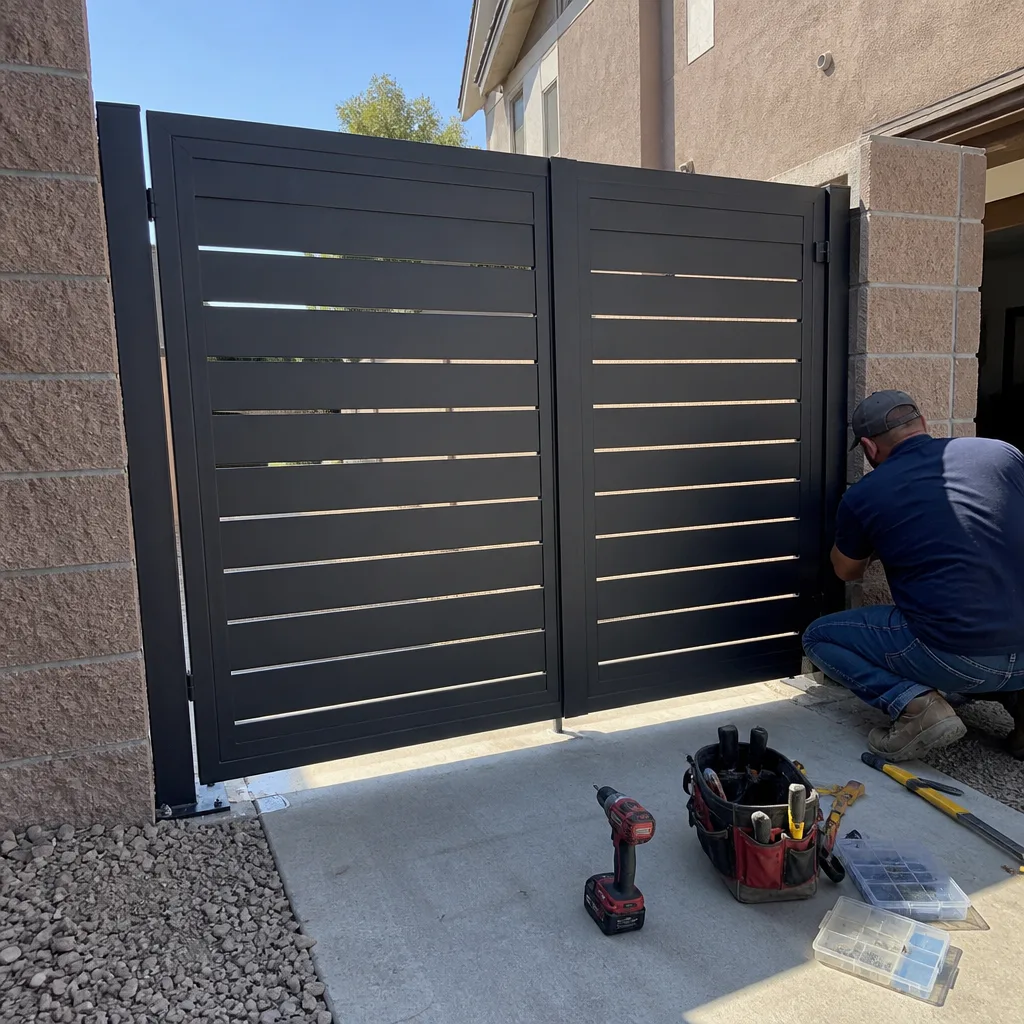 After
After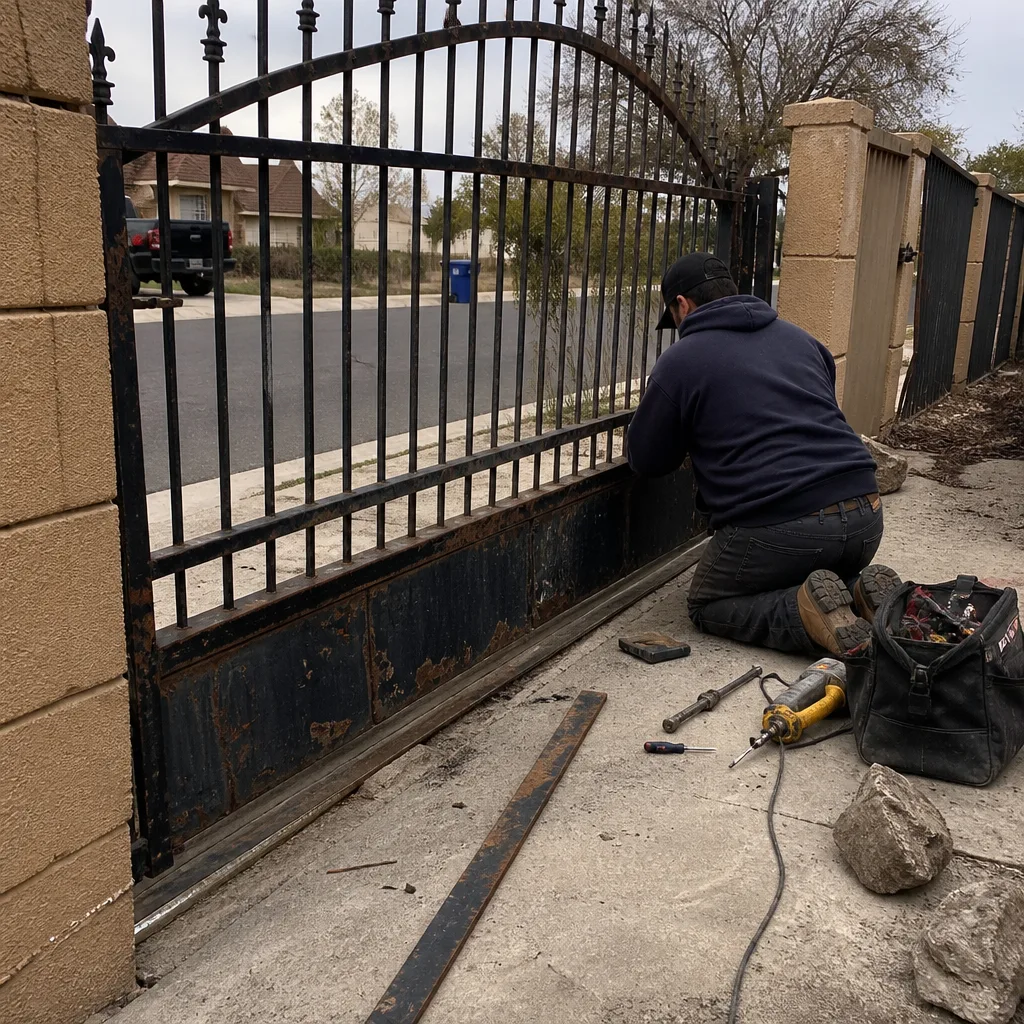 Before
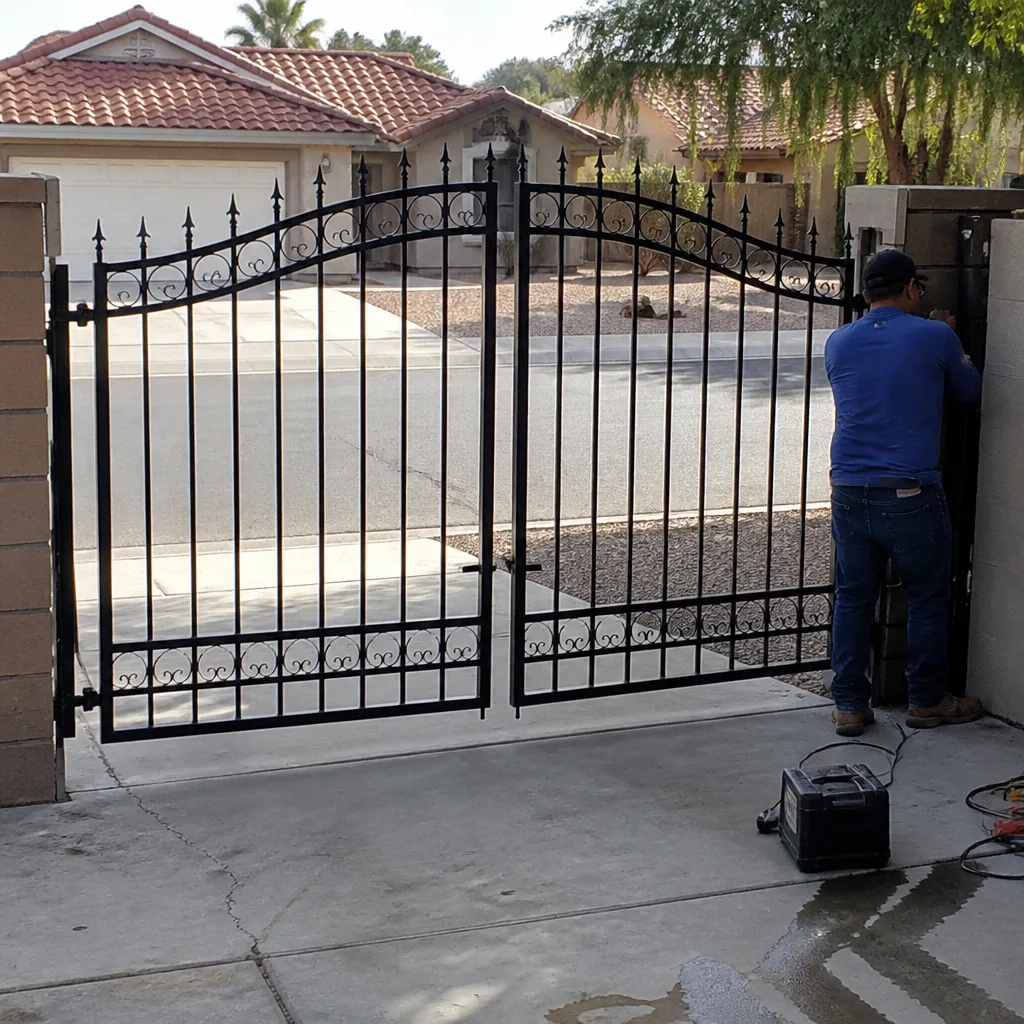 After
After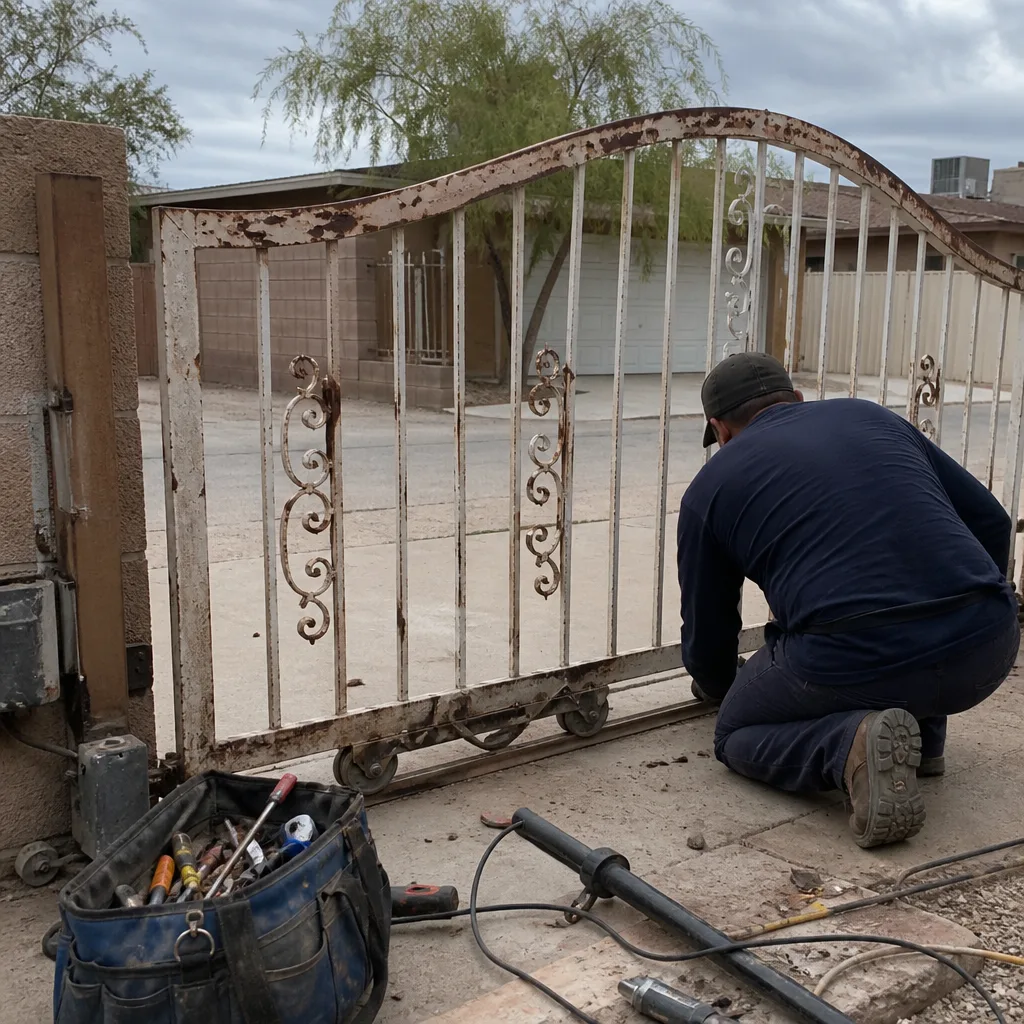 Before
 After
AfterWhen to Call a Professional
Call a professional when the gate makes a sound it didn’t make before, when the auto-reverse fails the 4×4 test, when the gate sags visibly, when the breaker trips more than once, or when any spring, cable, or line-voltage component is involved. These are not judgment calls. They are the line between a repair and an injury. Portcullis Gate Repair Las Vegas offers free estimates in Las Vegas. Call (725) 777-5391 and a live person answers, 24 hours a day, 7 days a week. We give a written price before any work starts, and every repair carries a 365-day written guarantee under the Kingswell Guarantee. If the repair fails within that year, we come back and fix it at no charge. That’s the deal, written down, on every invoice.
Frequently Asked Questions
Yes, for maintenance tasks like lubrication, battery replacement, and hardware tightening. Line-voltage electrical work on a gate operator triggers the same permitting process as any fixed electrical installation in Clark County, and UL 325 safety compliance applies to every automatic gate operator regardless of who does the work. If you’re replacing an operator or motor, the legal exposure belongs to the person who wires it.
The torsion spring. It stores hundreds of foot-pounds of energy even when the gate isn’t moving, and it releases all at once if the winding bars slip. Torsion spring adjustment is the one repair we tell every Las Vegas homeowner to skip, no matter how good their socket set is.
Most common repairs run $180 to $1,200 depending on the part and the labor. A keypad replacement is usually $180 – $350. An actuator swap is $650 – $1,000. A post replacement is $400 – $1,200. Every Portcullis job gets a written price before work starts, so the number on the invoice matches the number we quoted.
Tell the tech exactly what you did. We’ve seen half-finished spring adjustments, wrong-sized actuators, and miswired receiver boards, and all of them are fixable. Being upfront saves diagnostic time, and diagnostic time is the biggest variable in a repair bill after the parts themselves.
Yes. The 365-Day Done Right Promise covers any repair we perform, regardless of where the gate stood before we arrived. We put the guarantee in writing on the invoice, and if the repair fails within the year, we return and correct it at no charge under the same written promise.
For Tier 1 maintenance tasks, yes, by a wide margin. For actuator, spring, post, or wiring repairs, rarely. The parts cost is only part of the total. Tools, time, and the likely callback usually erase the savings. We’ve seen enough DIY actuator swaps that ended in a second, larger repair to know the math usually goes the other way.
The Bottom Line
The DIY-versus-pro decision on gate repair isn’t about how handy you are. It’s about which repair you’re facing, and what the consequences are if it goes wrong. Lubricate, tighten, replace batteries, and reprogram your keypad with confidence. When springs, line voltage, post footings, or safety sensors enter the picture, call a professional. Las Vegas heat and wind make gate failures both more common and more expensive when caught late, so the best money you’ll ever spend on a gate is the diagnostic call that catches a $200 repair before it becomes a $1,200 one. We’ve been doing this in Las Vegas since 2008, and the answer never changes: do the safe stuff yourself, and let a trained tech handle the dangerous stuff. For deeper reading, browse more guides & resources. The Kingswell Guarantee means the professional repair comes with the price in writing before we turn a bolt, and a year of backup if anything fails after we leave.
Written by Dean Prescott, Owner at Portcullis Gate Repair Las Vegas, serving Las Vegas since 2008.